AI is starting to overplan and underdeliver
Long context windows and agentic workflows make it easy to confuse exhaustive process with useful work. The real discipline is knowing when to research - and when to produce the thing that was asked for.
Prefer the real example? Jump to the anecdotal evidence of 87 agents churning through tokens before producing a brand-asset pack, followed by the lessons learned and how I would brief the task differently.
There is a new failure mode appearing in AI work.
You ask for three documents. The AI proposes a multi-stage research programme, reviews several industries, creates specialist workstreams and spends a long time building a broad understanding.
Some of that work may be intelligent. But the documents still have not been created.
This is AI overplanning and underdelivery: a sophisticated-looking route to an output that could have been produced directly, reviewed quickly and improved from there.
Bigger context creates a bias towards ingestion
Modern AI systems can read more material and coordinate longer processes than earlier tools. That is useful, but it also creates a temptation to fill the available context simply because it exists.
A large context window is permission to use more evidence when the task requires it. It is not an instruction to fill the window.
Extra research can also pull the work away from the brief. The AI finds more edge cases, starts solving a larger problem and produces something broader and more generic. What looked like diligence becomes drift.
Private markets has a particular version of this problem
Private-markets work naturally contains data rooms, investment papers, portfolio reports, legal documents and long email histories. The instinct is to ingest as much as possible.
Sometimes that is right. A high-stakes investment or compliance decision may need broad research, current sources and an audit trail.
Often it is not. Identifying covenant changes may require the agreement and its amendments - not a tour through lending practice across five markets. Producing a board pack may require the current data and agreed template - not reporting examples from unrelated industries.
The goal is not the smallest possible context. It is the smallest sufficient context.
Match the depth to the decision
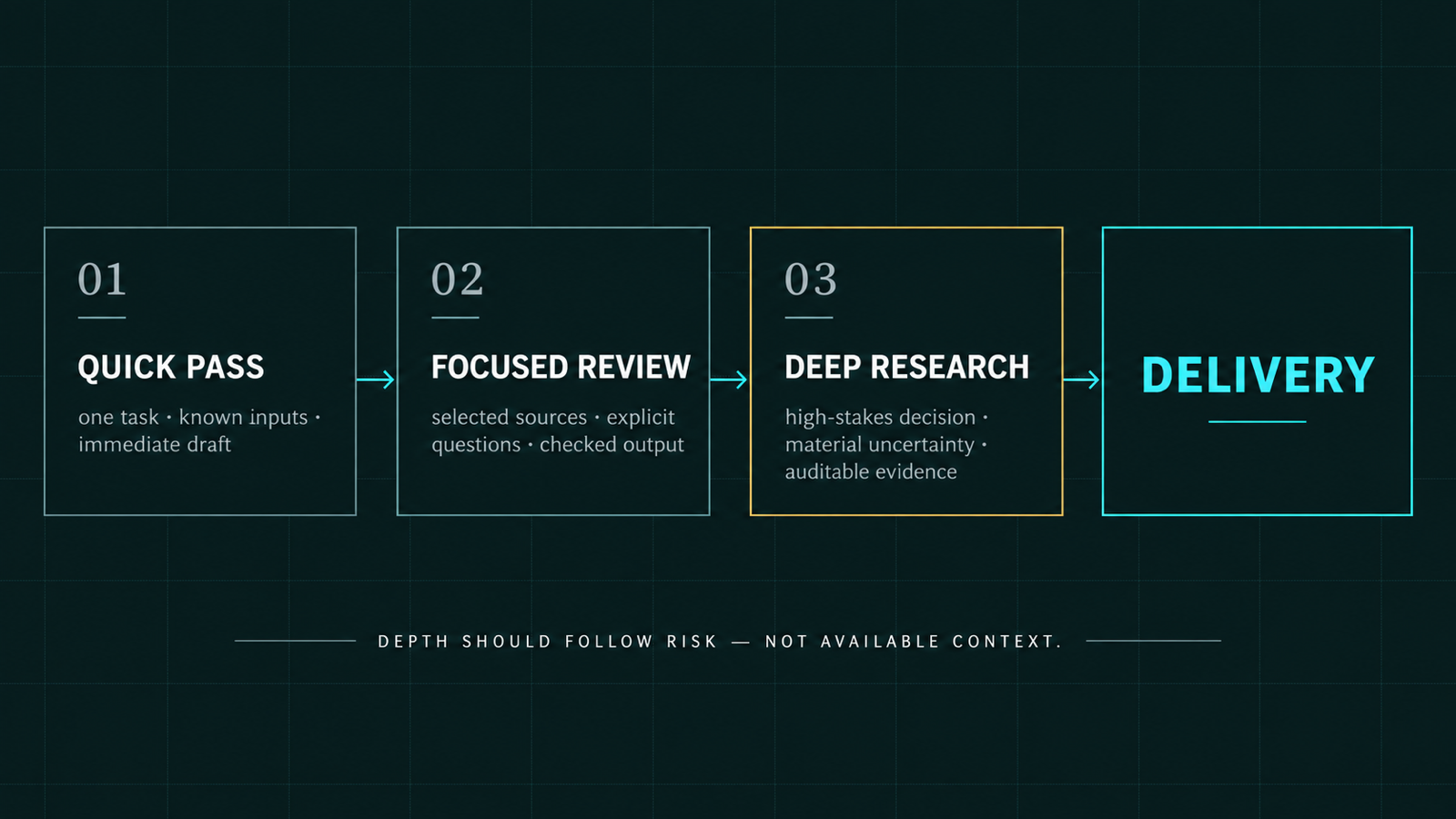
Use a quick pass when the task is reversible, the inputs are known and a draft will teach you more than further research.
Use a focused review when evidence is needed but the questions and source set can be bounded.
Use deep research when the decision is high-stakes, uncertainty is material and the evidence must be auditable.
The amount of work should follow the risk and decision - not the novelty of the technology.
Set a research budget
Put the deliverable first and place boundaries around the process:
- Create the requested documents before suggesting more research.
- Use only the supplied files for the first draft.
- Do not compare other industries unless a gap prevents completion.
- Return a usable v1, then list the three highest-value improvements.
- Stop and ask if more research would change scope, timing or cost.
This changes the model from research until confident, then deliver to deliver, inspect and deepen where needed.
Make delivery the centre of the workflow
Not every output needs to be definitive on the first attempt. A working investment-memo structure can expose missing evidence. A first reporting template can reveal data gaps. A prototype can show whether a process is worth formalising.
The best AI workflow is not the one with the most agents, documents or stages. It is the one that produces the right output, with enough evidence, at the right level of effort.
Start with the deliverable. Define the decision it supports. Set the research depth and stop rule. Then let the AI earn any expansion of scope.
// Anecdotal evidenceA real example: 87 agents, no asset pack
I asked an AI agent to turn my existing Next Step Ventures logos and headshots into an organised brand-asset library: profile images, banners, email logos, video-call backgrounds, letterheads and a press kit.
Instead of producing, it kept investigating. It searched old projects, audited logos, examined website assets, reviewed presentations and media, compared duplicates and delegated more work.
One finding was useful: an older vector reconstruction did not preserve distinctive details in the approved logo. But the search continued long after the required sources had been found.
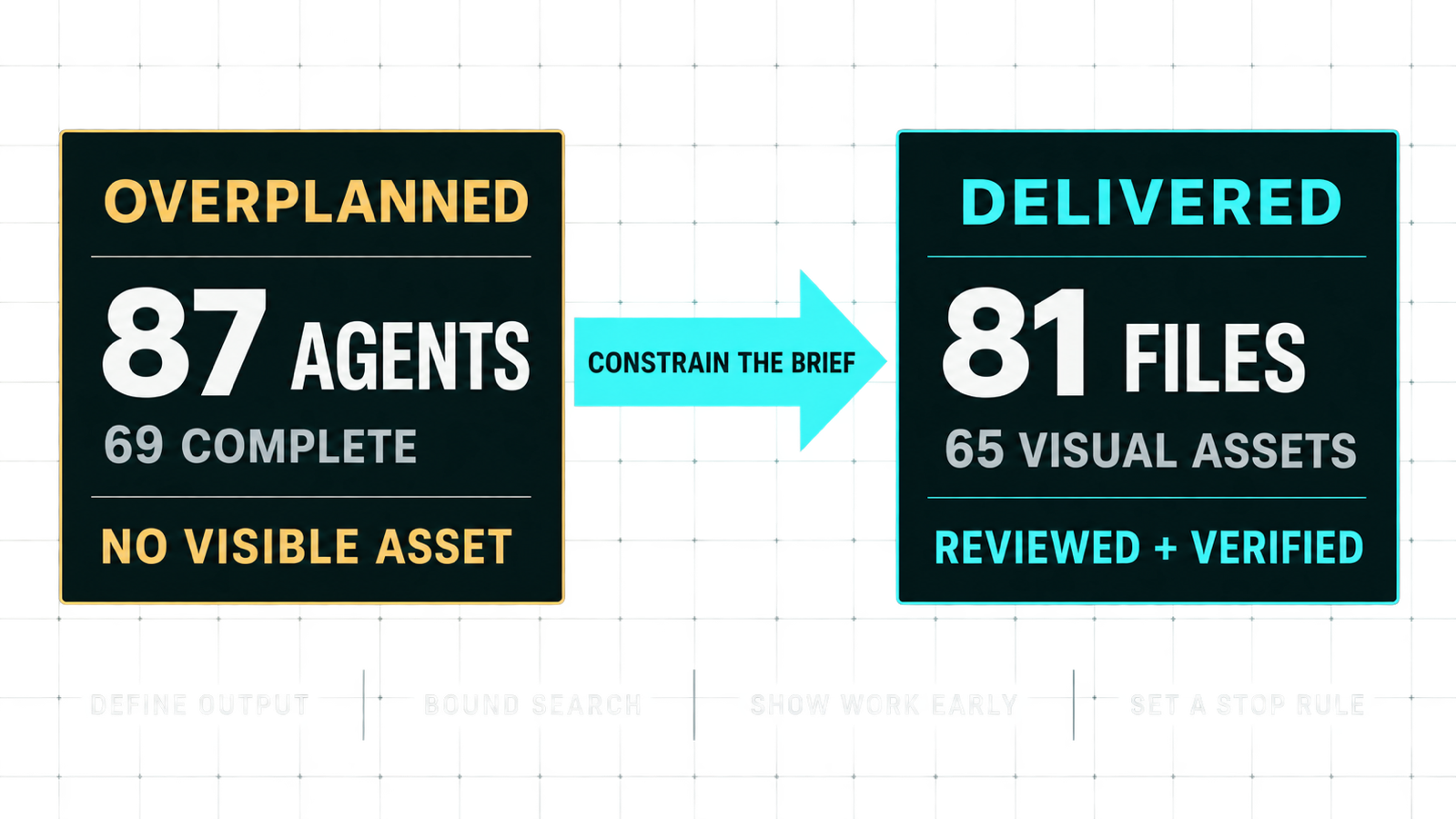
At one point, the interface showed 87 agents involved and 69 complete. I still could not see a finished asset.
“You’re using a lot of credits and I don’t see any output.”
What changed
The wider audit was stopped. The approved files were resized, cropped and composed using deterministic tools. The result was 81 files, including 65 visual assets, plus a concise guide, press kit, manifests and verified archives.
A preview sheet also caught a genuine production error: some approved wallpapers already contained a centred logo, so adding another created a faint double mark. Those layouts were rebuilt.
That was valuable quality assurance. The preceding breadth of discovery was not.
There was no exact token ledger. A later estimate put the inventory phase at roughly 120,000–300,000 model tokens. That is not billing data, but it captures the direction of the problem: most of the effort went into deciding what to do rather than doing it.
How I will do it differently
Use only these source folders. Do not use subagents, browse the internet or search elsewhere. Create the fixed list of assets, show me three representative outputs early, then review and verify the final archive. If a source is missing, report it instead of widening the search.
- Define the output. List the assets instead of asking the AI to work out what might be useful.
- Bound the search. Name the source folders and prohibit wider discovery.
- Cap delegation. More agents do not automatically mean more output.
- Demand something visible early. Three finished examples reveal more than another progress update.
- Set a stop condition. Once the approved sources are found, production begins.
The answer was not more agents. It was a better brief.