What an AI Operating Partner Actually Does Inside a Family Office
A practical guide to connecting a family office’s data, improving the work around investment decisions and building reviewed workflows the team can maintain.
An AI operating partner helps a family office connect its information and turn repetitive work into reliable, governed processes. The practical test for the principal is whether the team can prepare dependable answers and decisions with less reconstruction, while retaining the checks and accountability that matter.
The role combines workflow design, technical implementation, vendor assessment and staff training. It can be fractional or embedded, but someone must own the gaps between investment, finance, administration and IT, including the maintenance that follows a successful pilot.
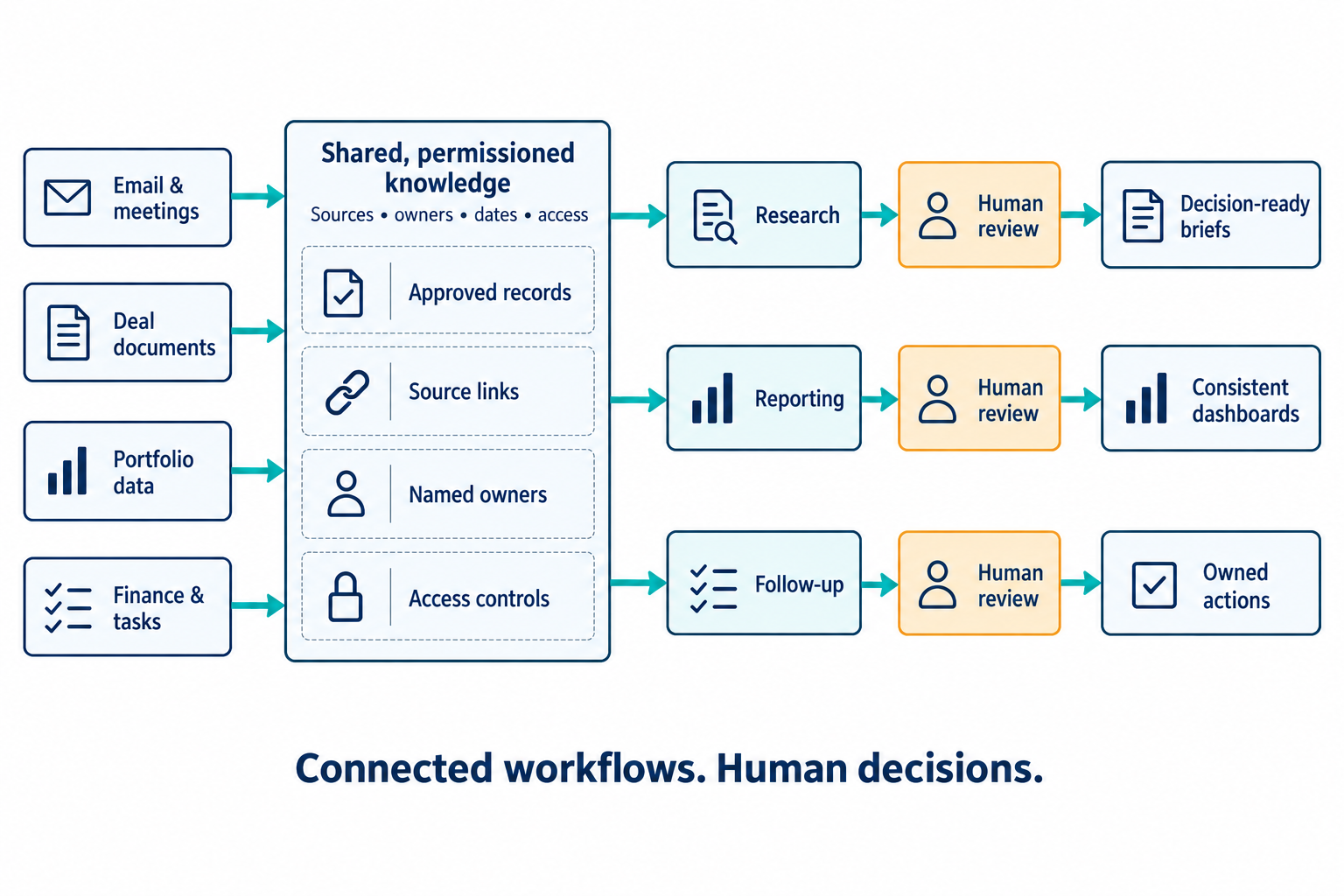
What the operating partner owns
The AI person your family office does not have yet might be the person responsible for turning experiments into processes the team actually uses. A CIO retains investment judgement, finance owns the numbers and an assistant understands the principal’s commitments; the operating partner helps those responsibilities work together through agreed data sources, repeatable steps and clear handovers.
Citi Institute’s family-office report, informed by discussions with principals and CIOs, emphasises privacy, lean operations and practical applications. That suggests a useful starting point: address administrative friction before making claims about investment outperformance.
Centralise the information people need to trust
If finance uses approved accounts while the investment team uses a draft spreadsheet, a new dashboard may simply reproduce the disagreement. The first task is to map the existing sources and agree which record is authoritative, who owns it and when it was updated.
The accounting system can remain authoritative for transactions, the portfolio platform for approved valuations and the document system for signed agreements. Centralisation means dependable, permissioned access across those systems, with common identifiers for entities, companies and deals. Reporting fields need consistent periods, currencies, units and definitions, including gross versus net performance.
Before connecting a tool, check contractual data use for training, retention, deletion, processing locations and subprocessors. Retrieval should enforce the requesting user’s permissions before material reaches the model, and generated reports must retain appropriate restrictions. Legal privilege, deal confidentiality and personal records need separate consideration.
Retrieval-augmented generation retrieves relevant material before drafting an answer. The research by Lewis and colleagues supports this approach on knowledge-intensive language tasks, but does not prove that a family office’s implementation will be accurate or permission-safe. Source links and access testing remain essential.
How the main workflows could change
These are illustrative starting points. An engagement should select a bottleneck with a clear owner, accessible data and a checkable output rather than attempt every process at once.
| Process | Current approach | Possible workflow and human control |
|---|---|---|
| Emails and meetings | Actions scattered across inboxes and notes. | Approved capture creates linked tasks with owners and deadlines; the meeting owner confirms them and approves external follow-ups. |
| Deal screening | Introductions and screening repeatedly reconstructed. | A shared pipeline checks mandate, conflicts, concentration and funding capacity; the investment lead decides whether to proceed. |
| Diligence and IC | Findings disconnected from model assumptions. | Source-linked evidence and unresolved questions populate an investment-committee (IC) draft for investment and adviser review. |
| Execution and monitoring | Obligations handed over manually after signing. | Reviewed terms become completion tasks and thesis-monitoring commitments; legal and investment teams retain approval. |
| Portfolio reporting | Several people rebuild the same figures. | Reconciled data feeds tailored reports and alerts; finance approves numbers and investment staff review interpretation. |
| Finance and administration | Invoices, capital calls and adviser deadlines chased manually. | Document classification and an owned deadline register support existing payment, tax and legal controls. |
| Principal and philanthropy support | Briefings, scheduling and grant reporting consume relationship time. | Draft briefs and tracked commitments support people who retain relationships, funding choices and communication approval. |
| Handovers | History and next steps depend on one person. | Permissioned records connect decisions, documents, tasks and contacts; process owners maintain and test cover arrangements. |
Investment work still needs investment judgement
For direct investments, AI can organise commercial, financial, management, legal, tax and cyber evidence, alongside relevant environmental and social risks. Its output should distinguish verified facts, management claims and assumptions, identifying contradictions, missing information and reasons to stop.
Valuation, cash conversion, leverage, downside cases, covenants and transaction terms still require professional review. Controlled spreadsheets or code should calculate returns and sensitivities from reconciled inputs, rather than generated arithmetic.
Fund commitments require manager, strategy, alignment, terms, operations and liquidity diligence. Track-record comparisons need attributable, realised versus unrealised and comparable gross/net measures; the ILPA Due Diligence Questionnaire provides a useful reference. Post-close workflows must also reflect actual rights: a controlling investor, minority shareholder and fund LP cannot demand the same information or interventions.
In practice: turn a monthly portfolio update into reviewed outputs
This is an illustrative workflow, not a client case study. An office receives company accounts and board packs each month. Finance needs reconciled figures, the investment team needs detail, and the principal wants an exceptions brief.
- Trigger and collect. An upload to an approved company folder starts the workflow. An existing automation or integration service links the document to its company, period, version and access group, retaining the original.
- Extract into a review table. AI proposes revenue, EBITDA, cash, net debt and agreed KPIs. Each value carries a document link, page or cell, date, units and review status. The instruction is specific: “Extract reported values with sources; flag conflicts; do not estimate missing figures.”
- Resolve an exception. Suppose the accounts and board pack show different cash balances for the same date. Both enter an exception queue. Finance investigates and approves the appropriate figure, retaining the explanation and originals.
- Calculate and draft. Controlled formulas calculate actual-versus-plan variances and any covenant headroom using agreed definitions. A reusable skill, meaning versioned instructions and templates, drafts the brief and dashboard commentary. Instructions guide the model; validation rules and approval permissions prevent unresolved metrics being released as approved.
- Review and distribute. Finance approves figures, the investment lead checks commentary, and authorised recipients receive their views of the same approved data. Material issues become assigned actions with deadlines; a failed extraction goes to manual review rather than silently disappearing.
An office with fund holdings would add commitments, calls, distributions and liquidity forecasts while controlling valuation dates and double-counted exposures. The aim is less reconciliation and more time investigating changes, tested against total preparation and review time, material corrections and overdue actions.
What a relevant case study shows
Anthropic’s BlueFlame case study describes investment-document processing, company comparisons and portfolio KPI extraction, reporting a reduction in document analysis from over four hours to minutes. This is a vendor-published claim, not an independently verified family-office benchmark or an NSV engagement. A pilot must test source coverage, accuracy and total review effort on the office’s own permitted documents.
What should exist after the first 90 days?
The sequence below is indicative, with timing dependent on access, data quality and complexity.
Days 1–15: map the work and select a pilot
Observe an actual reporting or diligence task with the people doing it, mapping sources, permissions, advisers, hand-offs and recurring corrections. Agree the first workflow, its owner, approved tools and success measures, producing a data-and-access map and a prioritised backlog.
Days 16–30: build and test a contained workflow
Connect only the required sources, define fields and review rules, and produce a usable first output. Test missing files, conflicting figures, restricted retrieval and a document containing malicious instructions to disclose data. Retain a manual fallback and record acceptance criteria before live use.
Days 31–60: establish real use
Run alongside the existing process until agreed checks pass, train users and measure preparation plus review effort. Verify what access and external-tool activity the chosen logging actually captures. The output is an accepted workflow with usage evidence and a go, revise or stop decision.
Days 61–90: make it maintainable
Assign support, costs, change control and incident responsibilities, then test a handover to someone other than the builder. Expand only after the office has a working guide, a usable fallback and evidence that the first process is worthwhile.
Questions to settle before an engagement
Ask what will improve first, where the data will go, who approves outputs and what would make the pilot stop. Include setup, subscriptions, integration, maintenance and human review in the cost, and agree what working capability and documentation remain if the operating partner leaves.
A proportionate initial vendor screen can be straightforward, but sensitive uses may need specialist security and legal assessment. The NIST AI Risk Management Framework helps structure ongoing risk management; it does not certify a tool as safe.
For a practical starting point, bring a recurring task to a short working session. The Next Step Ventures AI Operating Partner service starts with its inputs, checks and useful output, so the office can assess a bounded piece of work before committing to a wider programme.
This article discusses operating workflows, not investment, legal or tax advice. Examples are illustrative unless attributed. Sources checked on 27 September 2026.